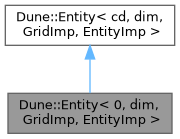
Template specialization of Dune::Entity for Elements (codim==0)
More...
#include <dune/grid/common/entity.hh>
|
| template<int codim> |
| Codim< codim >::Entity | subEntity (int i) const |
| | Obtain a subentity.
|
| |
| Entity | father () const |
| | Inter-level access to father entity on the next-coarser grid. The given entity resulted directly from a subdivision of its father entity. The behaviour for elements on the macro grid, that is when hasFather() is false, is undefined.
|
| |
| bool | hasFather () const |
| | Return true if entity has a father entity which can be accessed using the father() method.
|
| |
| bool | isLeaf () const |
| | Returns true if the entity is contained in the leaf grid.
|
| |
| bool | isRegular () const |
| | Returns true if element is of regular type in red/green type refinement. In bisection or hanging node refinement this is always true.
|
| |
| LocalGeometry | geometryInFather () const |
| | Provides information how this element has been subdivided from its father element.
|
| |
| HierarchicIterator | hbegin (int maxLevel) const |
| | Inter-level access to elements that resulted from (recursive) subdivision of this element.
|
| |
| HierarchicIterator | hend (int maxLevel) const |
| | Returns iterator to one past the last son element.
|
| |
| bool | isNew () const |
| | Returns true, if the entity has been created during the last call to adapt()
|
| |
| bool | mightVanish () const |
| | Returns true, if entity might disappear during the next call to adapt(). If the method returns false, the entity is guaranteed to still be present after adaptation.
|
| |
| bool | hasBoundaryIntersections () const |
| | Returns true, if entity has intersections with boundary.
|
| |
|
| | Entity (const EntityImp< 0, dim, GridImp > &e) |
| | Copy constructor from EntityImp.
|
| |
| | Entity (EntityImp< 0, dim, GridImp > &&e) |
| | Move constructor from EntityImp.
|
| |
|
Iterator range for hierarchic access to the more-refined entities that result from the subdivision of a given element.
|
| template<typename Entity > |
| IteratorRange<... > | descendantElements (const Entity &e, int maxLevel) |
| | Iterates over all descendant elements of the given element up to a maximum level.
|
| |
Template specialization of Dune::Entity for Elements (codim==0)
- Template Parameters
-
| dim | Dimension of the grid |
| GridImp | Type that is a model of Dune::Grid |
| EntityImp | Class template that is a model of Dune::Entity |
- See also
- Dune::Entity (general version) for the full documentation
<int cd, int dim, class GridImp, template<int,int,class> class EntityImp>
◆ EntitySeed
The corresponding entity seed (for storage of entities)
◆ Geometry
The geometry type of this entity.
◆ HierarchicIterator
The HierarchicIterator type.
◆ Implementation
Type of underlying implementation.
- Note
- This code may change without prior warning
◆ LocalGeometry
The geometry type of this entity when the geometry is expressed embedded in the father element.
This differs from Geometry in particular when dim != dimworld, but even when dim == dimworld the implementation may choose to use a different type here.
◆ Entity() [1/5]
◆ Entity() [2/5]
Copy constructor from an existing entity.
◆ Entity() [3/5]
Move constructor from an existing entity.
◆ Entity() [4/5]
Copy constructor from EntityImp.
◆ Entity() [5/5]
Move constructor from EntityImp.
◆ father()
Inter-level access to father entity on the next-coarser grid. The given entity resulted directly from a subdivision of its father entity. The behaviour for elements on the macro grid, that is when hasFather() is false, is undefined.
- Note
- If the partitionType of the Entity is GhostEntity, it is not guaranteed that this method is working or implemented in general. For some grids it might be available, though.
◆ geometry()
obtain geometric realization of the entity
Each entity provides an object of type Dune::Geometry< dimension-codimension, dimensionworld, ... > that represents the map from a reference element to world coordinates.
- Note
- Previously, the geometry was encapsulated in the entity object and a const reference was returned.
-
The returned geometry object is guaranteed to remain valid until the grid is modified (or deleted).
◆ geometryInFather()
Provides information how this element has been subdivided from its father element.
The returned LocalGeometry is a model of Dune::Geometry<dimension,dimension,...>, mapping the reference element of the given entity to the reference element of its father.
This information is sufficient to interpolate all degrees of freedom in the conforming case. Nonconforming may require access to neighbors of the father and calculations with local coordinates. The on-the-fly case is somewhat inefficient since degrees of freedom may be visited several times. If we store interpolation matrices, this is tolerable. We assume that on-the-fly implementation of interpolation is only done for simple discretizations.
- Note
- For ghost entities, this method is not guaranteed to be implemented.
-
Previously, the geometry was encapsulated in the entity object and a const reference was returned.
-
The returned geometry object is guaranteed to remain valid until the grid is modified (or deleted).
◆ hasBoundaryIntersections()
Returns true, if entity has intersections with boundary.
◆ hasFather()
Return true if entity has a father entity which can be accessed using the father() method.
◆ hbegin()
Inter-level access to elements that resulted from (recursive) subdivision of this element.
- Parameters
-
| [in] | maxLevel | Iterator does not stop at elements with level greater than maxlevel. |
- Returns
- Iterator to the first son (level is not greater than maxlevel)
- Note
- If the partitionType of the Entity is GhostEntity, it is not guaranteed that this method is working or implemented in general. For some grids it might be available, though.
◆ hend()
Returns iterator to one past the last son element.
- Note
- If the partitionType of the Entity is GhostEntity, it is not guaranteed that this method is working or implemented in general. For some grids it might be available, though.
◆ impl() [1/2]
Return reference to the real implementation.
◆ impl() [2/2]
Return const reference to the real implementation.
◆ isLeaf()
Returns true if the entity is contained in the leaf grid.
◆ isNew()
Returns true, if the entity has been created during the last call to adapt()
◆ isRegular()
Returns true if element is of regular type in red/green type refinement. In bisection or hanging node refinement this is always true.
◆ level()
The level of this entity.
◆ mightVanish()
Returns true, if entity might disappear during the next call to adapt(). If the method returns false, the entity is guaranteed to still be present after adaptation.
◆ operator!=()
Compares two entities for inequality.
◆ operator=() [1/2]
Copy assignment operator from an existing entity.
◆ operator=() [2/2]
Move assignment operator from an existing entity.
◆ operator==()
Compares two entities for equality.
◆ partitionType()
Partition type of this entity.
◆ seed()
Return the entity seed which contains sufficient information to generate the entity again and uses as little memory as possible.
◆ subEntities()
Number of subentities for a given codimension.
- Parameters
-
| codim | codimension to obtain number of subentities for |
- Note
- The codimension is specified with respect to the grid dimension.
-
Unless the geometry type is None, this method is redundant and the same information can be obtained from the corresponding reference element.
◆ subEntity()
template<int dim, class GridImp , template< int, int, class > class EntityImp>
template<int codim>
Obtain a subentity.
- Template Parameters
-
| codim | codimension of the desired subentity |
- Parameters
-
| [in] | i | number of the subentity (in generic numbering) |
- Returns
- the specified subentity
- Note
- The subentities are numbered 0, ..., subEntities( codim )-1
◆ type()
Return the name of the reference element. The type can be used to access the Dune::ReferenceElement.
◆ referenceElement()
Second-level dispatch to select the correct reference element for a grid entity.
This function is the default implementation of the second-level reference element dispatch performed by Entity.
When referenceElement() is called with an Entity, it will forward the call to referenceElement<ctype, mydim>(const GeometryType&). This default implementation will do the right thing as long as your geometry is based on a standard Dune ReferenceElement. If it is not and you want to supply your own reference element implementation, provide an override of this function for your specific geometry implementation.
◆ codimension
Know your own codimension.
◆ dimension
Know the grid's dimension.
◆ mydimension
Know dimension of the entity.
◆ realEntity
The documentation for this class was generated from the following file:
 1.9.8
1.9.8