 |
Dune-Fufem 2.11-git
|
Loading...
Searching...
No Matches
Classes |
Public Types |
Public Member Functions |
Static Public Attributes |
Protected Types |
Static Protected Member Functions |
Protected Attributes |
List of all members
Dune::Fufem::Forms::FEOperatorBase< B, TP, argIndex > Class Template Reference
Base class of elementary differential operators on an FE-space. More...
#include <dune/fufem/forms/unaryoperators.hh>
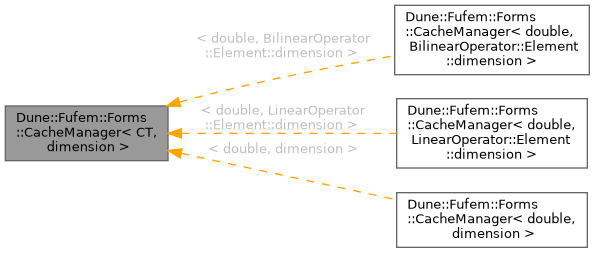
Inheritance diagram for Dune::Fufem::Forms::FEOperatorBase< B, TP, argIndex >:
Classes | |
| class | LocalOperator |
Public Types | |
| using | Element = typename Basis::LocalView::Element |
| using | Intersection = typename Basis::GridView::Intersection |
Public Member Functions | |
| FEOperatorBase (const Basis &basis, const TreePath &treePath, bool isAffine=true) | |
| auto | basis () const |
| auto | treePath () const |
| bool | isAffine () const |
| template<std::size_t k> | |
| FEOperatorBase< B, TP, k > | rebindArgIndex () const |
| Get a copy of this operator bound to another argument. | |
Static Public Attributes | |
| static constexpr std::size_t | argIndex |
| static constexpr std::size_t | arity |
Protected Types | |
| using | LocalView = typename B::LocalView |
| using | Tree = typename LocalView::Tree |
| using | Node = typename Dune::TypeTree::ChildForTreePath< Tree, TP > |
| using | SubspaceBasis = typename Dune::Functions::SubspaceBasis< B, TP > |
| using | LeafTreePath = decltype(leafTreePath(std::declval< TP >())) |
| using | LeafNode = typename Dune::TypeTree::ChildForTreePath< Tree, LeafTreePath > |
| using | Basis = B |
| using | TreePath = TP |
Static Protected Member Functions | |
| static auto | leafTreePath (const TP &tp) |
Protected Attributes | |
| SubspaceBasis | subspaceBasis_ |
| bool | isAffine_ |
Detailed Description
template<class B, class TP, std::size_t argIndex>
class Dune::Fufem::Forms::FEOperatorBase< B, TP, argIndex >
class Dune::Fufem::Forms::FEOperatorBase< B, TP, argIndex >
Base class of elementary differential operators on an FE-space.
- Template Parameters
-
B Type of the dune-functions basis TP Tree path within the basis argIndex Index of arguments within composed multilinear operators
This class contains all the generic management of bases, trees, nodes, caches that is invariant under the linear (differential) operator.
Member Typedef Documentation
◆ Basis
template<class B , class TP , std::size_t argIndex>
|
protected |
◆ Element
template<class B , class TP , std::size_t argIndex>
| using Dune::Fufem::Forms::FEOperatorBase< B, TP, argIndex >::Element = typename Basis::LocalView::Element |
◆ Intersection
template<class B , class TP , std::size_t argIndex>
| using Dune::Fufem::Forms::FEOperatorBase< B, TP, argIndex >::Intersection = typename Basis::GridView::Intersection |
◆ LeafNode
template<class B , class TP , std::size_t argIndex>
|
protected |
◆ LeafTreePath
template<class B , class TP , std::size_t argIndex>
|
protected |
◆ LocalView
template<class B , class TP , std::size_t argIndex>
|
protected |
◆ Node
template<class B , class TP , std::size_t argIndex>
|
protected |
◆ SubspaceBasis
template<class B , class TP , std::size_t argIndex>
|
protected |
◆ Tree
template<class B , class TP , std::size_t argIndex>
|
protected |
◆ TreePath
template<class B , class TP , std::size_t argIndex>
|
protected |
Constructor & Destructor Documentation
◆ FEOperatorBase()
template<class B , class TP , std::size_t argIndex>
|
inline |
Member Function Documentation
◆ basis()
template<class B , class TP , std::size_t argIndex>
|
inline |
◆ isAffine()
template<class B , class TP , std::size_t argIndex>
|
inline |
◆ leafTreePath()
template<class B , class TP , std::size_t argIndex>
|
inlinestaticprotected |
◆ rebindArgIndex()
template<class B , class TP , std::size_t argIndex>
template<std::size_t k>
|
inline |
Get a copy of this operator bound to another argument.
- Template Parameters
-
k Index of the new argument this should be bound to.
◆ treePath()
template<class B , class TP , std::size_t argIndex>
|
inline |
Member Data Documentation
◆ argIndex
|
staticconstexprinherited |
◆ arity
|
staticconstexprinherited |
◆ isAffine_
template<class B , class TP , std::size_t argIndex>
|
protected |
◆ subspaceBasis_
template<class B , class TP , std::size_t argIndex>
|
protected |
The documentation for this class was generated from the following file:
-
Legal Statements / Impressum
|
Hosted by TU Dresden & Uni Heidelberg |
Generated by
 1.9.8
1.9.8